Quantum computing is a bit like TikTok. In a relatively short time, TikTok reshaped how media is consumed and shifted the mindset of video creation and consumption. It even shifted the dominant video format from landscape to portrait, and landscape had a 100-year head start! Classical computing has roughly that same head start over quantum.
Quantum computing isn’t a faster version of today’s computers. It’s a fundamentally different kind of machine, based on quantum physics, that approaches certain problems in a completely different way, allowing it to tackle challenges that would overwhelm even the most powerful classical supercomputers.
Classical vs. Quantum Computing: A Different Foundation
Classical computers, from the videos on your phone to your laptop and even the machines running the most advanced data centers ever built, all work in essentially the same way. Everything they do relies on tiny switches that are either off (0) or on (1). These switches, called bits, are the foundation of all classical computing. Because only a single state can be represented at one time, classical computers work through problems one step at a time. Even when systems use multiple CPUs or massive parallel infrastructure, each individual calculation still follows a fixed, sequential path, just executed extremely fast and at an enormous scale.
Quantum computers start from a different foundation. Instead of bits, they use qubits. A qubit does not have to be just a 0 or a 1. It can represent a blend of possibilities at the same time, more like a coin spinning in the air than one lying flat on a table. This allows quantum computers to work with many potential states simultaneously rather than evaluating them one by one. The result is a fundamentally different way of approaching certain problems. It is a way of exploring vast numbers of possibilities and narrowing in on viable solutions in ways classical computers simply cannot.
When Classical Computing Hits a Wall
For some problems, especially those with massive numbers of possible combinations, classical computers cannot keep up. Even with modern supercomputers, there are situations where the number of possibilities grows so fast that checking them all becomes unrealistic.
You may have heard that modern encryption relies on extremely large numbers that would take a classical supercomputer thousands or even millions of years to break. A sufficiently powerful quantum computer could theoretically solve that same problem in hours or days.
Similarly, in drug research, simulating how a complex molecule behaves can take classical supercomputers years and still require approximations, while a mature quantum computer could model those interactions more precisely and potentially much faster.
Instead of using brute force to try different possibilities one at a time, a quantum computer can eliminate many incorrect answers all at once and narrow in on answers that satisfy the rules of the problem. Think back to basic algebra. When the same factor appears on the top and bottom of a fraction, it cancels out and disappears. Quantum computers work in a similar way. As the calculation runs, certain combinations, the wrong answers, begin to cancel each other out, while the right answers remain. When we finally check the result, the correct answer is much more likely to stand out.
Not a Replacement for Classical Computers
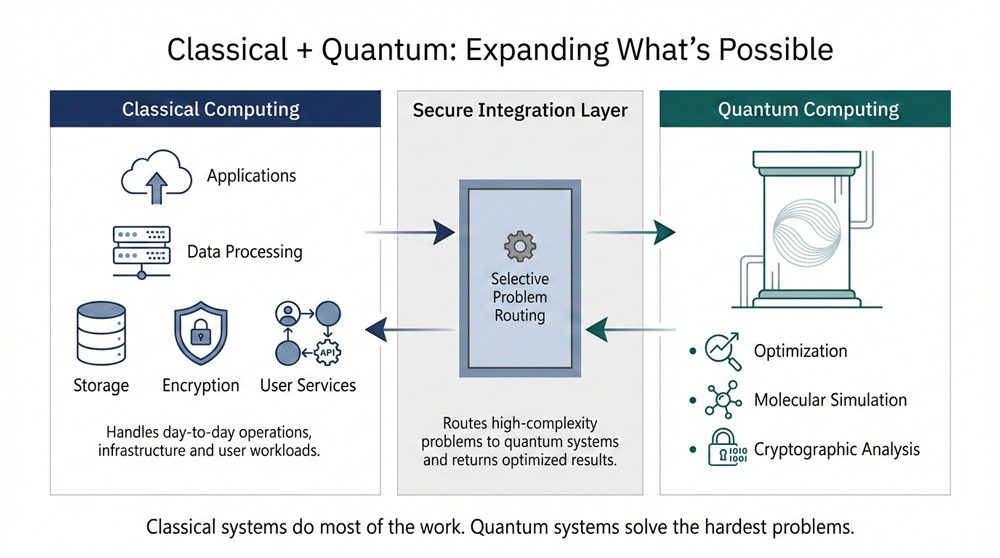
Quantum computers are not general-purpose machines. They will not run your email, host websites or replace cloud infrastructure. But they show promise in areas where today’s computers struggle, such as optimizing energy distribution across regional grids, modeling how complex drug molecules interact at the atomic level and planning large-scale transportation or disaster response logistics where the number of possible scenarios grows exponentially.
Quantum computers are also still relatively limited. They are expensive, fragile and difficult to operate. Many of the most powerful use cases remain experimental. This is not technology that organizations will roll out the way they did cloud computing or AI. The real promise lies in quantum systems working alongside classical computers.
In the future, classical systems will continue handling most of what they do today, such as data processing, storage and user applications, while quantum machines are called on to solve specific, high-complexity problems in the background.
For example, a classical system might manage encrypted communications, while a quantum system helps test and strengthen new post-quantum security methods. Or a traditional supercomputer might process clinical trial data, while a quantum processor simulates the molecular behavior of a potential drug candidate.
What Leaders Should Do Now
So what do we need to do over the next few years?
First, prepare for the security transition. Even though large-scale quantum computers are not yet practical, organizations should begin planning for post-quantum cryptography. Today’s most widely used public-key encryption methods are expected to be vulnerable to sufficiently powerful quantum computers, which is why planning for post-quantum cryptography has already begun. The National Institute of Standards and Technology (NIST) has already identified new post-quantum cryptographic standards, signaling that the transition is no longer theoretical but underway. Preparing for that transition begins with inventorying where encryption is used, identifying systems that protect long-lived sensitive data and building upgrade paths in advance.
Second, design for a hybrid future. Quantum computers will not replace classical systems; they will augment them. Leaders should identify mission areas where complexity is growing and monitor where quantum advancements could provide an advantage. The goal is to ensure architectures, data pipelines and partnerships are flexible enough to integrate quantum services when they become practical.
Third, stay informed and build literacy. Quantum computing is evolving quickly, and separating signal from hype matters. Agencies and industry leaders should designate subject matter owners, track federal standards and engage with academic and private-sector efforts. Building organizational awareness now ensures decisions over the next decade are intentional rather than reactive.
Expanding the Boundaries of What Is Possible
Quantum computing expands the boundaries of what can be solved. Just as classical computing reshaped communication, commerce and national infrastructure over the last century, quantum computing has the potential to reshape how we tackle the hardest scientific, security and logistical challenges ahead.
The organizations that approach it intentionally will be the ones best positioned to use it responsibly and strategically when its capabilities mature. In government especially, it will be imperative not to be surprised when quantum arrives.